For startups and fast-growing technology companies, security and compliance should enable growth—not slow it down.
As organizations begin working with enterprise customers, entering new markets, or handling sensitive customer data, security requirements quickly become part of the sales process. Prospects may ask for SOC 2, ISO/IEC 27001, VAPT, GDPR, HIPAA, PCI DSS, AI security controls, or detailed security questionnaires before they approve a vendor.
For a growing company, meeting these requirements can become a significant operational challenge. Policies need to be created and maintained, controls need to be implemented, evidence needs to be collected, risks need to be addressed, and teams need to prepare for an independent audit or assessment.

This is where Make Audit Easy (MAE) helps.
We combine cybersecurity expertise, compliance implementation, audit readiness, and practical technology guidance to help organizations move from compliance requirements to audit readiness with greater speed and less operational disruption.
Our objective is simple:
Help you become secure, compliant, and audit-ready—without taking your focus away from growth.
The Compliance Challenge for Fast-Growing Companies
Growth changes the compliance equation.
A startup may initially operate with a small team, informal processes, and limited documentation. As the company grows, enterprise customers, investors, regulators, and partners increasingly expect formal security practices and demonstrable controls.
This creates several common challenges.
1. Enterprise Customers Expect Proof of Security
Large customers increasingly conduct security and vendor-risk assessments before signing contracts.
A prospective customer may ask:
- Do you have SOC 2?
- Are you ISO 27001 certified?
- Can you provide a recent VAPT report?
- How do you manage access controls?
- Do you have a formal incident-response process?
- How do you manage third-party vendors?
- Can you provide evidence for your security controls?
When these requirements appear during procurement, a company that is not prepared can face additional reviews, remediation requests, or delays.
2. Compliance Can Consume Valuable Engineering Time
Compliance often requires evidence from multiple areas of the organization—engineering, DevOps, HR, IT, security, finance, and management.
Without a structured approach, developers and technology leaders may spend significant time:
- Searching for evidence
- Completing spreadsheets
- Updating policies
- Responding to questionnaires
- Documenting technical controls
- Tracking remediation activities
- Preparing for audit meetings
That is time that could otherwise be spent building the product and serving customers.
3. Requirements Keep Changing
Compliance is no longer a one-time documentation exercise.
Customers introduce new security questionnaires. Regulations evolve. New technologies such as AI introduce additional security and governance requirements. Organizations entering new geographies may also encounter new regulatory obligations.
Your compliance program therefore needs to be practical, maintainable, and capable of evolving with the business.
How Make Audit Easy Helps
Make Audit Easy is built for organizations that need to move quickly.
We provide end-to-end support across compliance implementation, cybersecurity assessments, audit readiness, and certification preparation.
Instead of treating compliance as a collection of documents, we look at the organization as a whole—its people, processes, technology, risks, and business requirements.
Our approach combines four key elements:
Expertise + Technology + Structured Implementation + Audit Readiness
This enables organizations to build compliance into their existing operations rather than creating a separate compliance burden.
1. Start With a Clear Gap Assessment
Before implementing controls, we establish where the organization currently stands.
Our assessment can identify:
- Existing controls
- Missing controls
- Documentation gaps
- Security weaknesses
- Risk areas
- Evidence gaps
- Ownership requirements
- Priority remediation items
The result is a practical roadmap showing what needs to be addressed, why it matters, who should own it, and what evidence will ultimately be required.
2. Turn Compliance Requirements Into Action
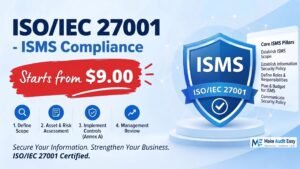
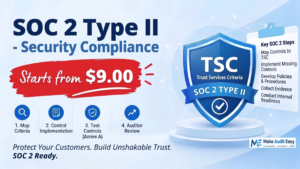
Frameworks such as SOC 2 and ISO/IEC 27001 contain extensive requirements.
The challenge is not simply understanding the standard. The real challenge is translating those requirements into actions that work within your organization.
MAE helps convert requirements into practical activities such as:
- Policies and procedures
- Risk assessments
- Asset management
- Access management
- Security awareness
- Incident management
- Vendor management
- Business continuity
- Vulnerability management
- Change management
- Logging and monitoring
- Backup and recovery
- HR security processes
- Technical and operational controls
This gives teams a clear path from requirement → control → implementation → evidence → audit readiness.
3. Work With Your Existing Technology Stack
Compliance should not require rebuilding your entire technology environment.
Our experts work with your existing infrastructure, applications, cloud environments, DevOps processes, and security tools to determine how required controls can be implemented efficiently.
Where appropriate, we help integrate compliance activities into existing workflows so that evidence can be generated as part of normal business operations.
The goal is to make compliance part of the way you operate—not an additional project that appears before an audit.
4. Reduce the Burden on Engineering Teams
Your developers should be building your product.
MAE helps organize the compliance workload so that engineering involvement is focused primarily on the areas where technical input is actually required.
We help manage:
- Evidence requirements
- Control mapping
- Documentation
- Compliance trackers
- Remediation tracking
- Audit preparation
- Security questionnaires
- Auditor coordination
This allows internal teams to spend less time managing compliance administration and more time focusing on the business.
5. Prepare You for the Independent Audit
Implementation is only part of the journey.
Organizations also need to demonstrate that controls are operating effectively and that appropriate evidence exists.
MAE supports the organization through:
Gap Assessment → Implementation → Remediation → Internal Audit → Evidence Readiness → External Audit Coordination
For applicable frameworks, the final certification or attestation is performed by the appropriate independent certification body or audit/attestation firm.
Our role is to help you arrive at that stage prepared, organized, and audit-ready.
Built for Startups and High-Growth Companies
Large enterprises may have dedicated compliance, security, legal, and audit teams.
Startups often do not.
That is why MAE focuses on providing enterprise-grade compliance expertise without requiring startups to build a large internal compliance organization.
We work with:
- SaaS companies
- B2B technology companies
- FinTech and financial technology organizations
- AI companies
- Cloud and IT service providers
- E-commerce companies
- Startups preparing for enterprise sales
- Growing companies entering regulated markets
- Organizations preparing for SOC 2 or ISO 27001
Whether you are preparing for your first major enterprise customer or expanding into new markets, we help create a structured path toward compliance.
Traditional Compliance Consulting vs. The Make Audit Easy Approach
| Area | Traditional Approach | Make Audit Easy Approach |
|---|---|---|
| Starting Point | Often begins with documentation | Starts with business, technology, risk and compliance requirements |
| Gap Assessment | High-level observations | Requirement-level gaps, priorities, owners and remediation actions |
| Implementation | Heavy reliance on client teams | Guided, hands-on implementation support |
| Evidence | Often collected toward the end | Evidence requirements considered throughout implementation |
| Engineering Effort | Can create significant administrative overhead | Focused involvement where technical action is required |
| Documentation | Templates may be provided with limited guidance | Documentation aligned to actual processes and controls |
| Changing Requirements | Periodic review | Designed to adapt to customer and regulatory requirements |
| Internal Audit | May be treated as a separate activity | Integrated into the audit-readiness journey |
| External Audit | Client manages much of the coordination | MAE supports audit preparation and coordination |
| Business Focus | Compliance as a project | Compliance as an enabler of growth |
Compliance That Moves at the Speed of Your Business
A growing company should not have to choose between building the business and building its compliance program.
The right compliance approach can help organizations:
- Respond to enterprise security questionnaires faster
- Build customer trust
- Reduce security and operational risks
- Establish repeatable processes
- Prepare for independent audits
- Support expansion into new markets
- Strengthen internal security practices
- Create a foundation for future compliance requirements
At Make Audit Easy, we bring together cybersecurity professionals, compliance expertise, structured implementation, and practical technology guidance to make that journey simpler.
From Requirement to Readiness. From Readiness to Trust.
Make Audit Easy — helping startups and growing organizations become secure, compliant, and ready for their next stage of growth.
SOC 2 | ISO/IEC 27001 | VAPT | PCI DSS | AI Security | ISO/IEC 42001 | GDPR | HIPAA | vCISO | Cybersecurity & Compliance